
Grandfather and grandson sitting on a dock by a lake watching beautiful sunset.

Retirement Location Planning Checklist for High-Net-Worth Families

State tax policies are changing, and for many high-net-worth individuals and families, where they live in retirement has real financial consequences. But the best place to start isn’t the tax table. It’s getting clear on how you want to live, then working through the tax, cash flow, estate, and planning tradeoffs in the places you’d genuinely like to call home.  

When evaluating retirement location, a better starting point is to focus on how you want to live, then work through the tax, cash flow, estate, and planning tradeoffs within the places you would genuinely want to call home. 
How to Use This Checklist

Before getting deep into state-by-state comparisons, use these questions to help frame the right conversations before evaluating specific tax differences.

1. Lifestyle Alignment Comes First

  • Have you defined what you want your day-to-day life in retirement to look like?  
  • How important is proximity to children, grandchildren, friends, or community?  
  • What lifestyle factors matter most, such as climate, travel, golf, outdoor activities, or cultural amenities?  
  • Do you want one primary residence, or do you expect to split time between multiple homes?  
  • Would you still be interested in this location if the tax benefit were not the main draw?  

2. Residency Rules and Practical Reality

  • Do you understand what it would take to establish and maintain residency in another state?  
  • How many days do you realistically expect to spend in each location throughout the year?  
  • Are you prepared to move your banking and professional relationships—doctors, advisors, attorneys—to the new state? 
  • Are you prepared to document your residence pattern if your prior state challenges the change? 
  • Where are your strongest personal, financial, and community ties today?  
  • Would a second home support your goals without requiring a full relocation?  
  • Are you prepared to document your residency pattern if needed?  

3. Total Cost of Living and Wealth Preservation

  • Once you factor in housing, insurance, healthcare, travel, and other lifestyle costs, does the lower-tax state still make financial sense?  
  • Have you modeled how each location could affect long-term cash flow and asset preservation?  
  • Will your spending needs change materially depending on where you live?  
  • Do you have enough liquidity and flexibility to adapt over time?  

4. Estate Planning and Generational Considerations

  • How would each location affect estate taxes, trust planning, and wealth transfer strategies?
  • Are your current estate documents and trust structures aligned with your long-term goals?  
  • Would a different trust jurisdiction or planning structure better support your family’s needs?  
  • Have you considered how your choice of location fits with your broader goals for philanthropy, family governance, and multigenerational planning?  

5. Flexibility and Optionality

  • Do you need to make a permanent move right away, or would a phased approach make more sense?  
  • Would maintaining multiple residences create more flexibility for your family? 
  • Have you considered trying a location before making it your primary home? 
  • If health, family needs, or priorities change, are your financial plan and living arrangements flexible enough to change with them?  

6. If You Own a Business, the Analysis Gets More Complex

  • How is your business income taxed today, and how could that change if you move?  
  • Where is revenue generated, and where does the business have operational or tax exposure?  
  • Are you considering a sale, recapitalization, succession plan, or other ownership transition?  
  • Could the timing of your move affect the after-tax outcome of a future liquidity event?  
  • If a sale or transition occurs, should you evaluate whether a Family Office or Family Office-style approach makes sense for the next chapter?  

7. Not Planning to Move? There Is Still Plenty To Think About

  • How will your income shift once salary, bonus, or business income changes?  
  • Is your withdrawal strategy aligned with those changes? 
  • Are there opportunities to manage taxable income before or during retirement?  
  • Are your estate documents, trust structures, and beneficiary designations current?  
  • Have you planned for housing, insurance, healthcare, and aging in place?  
  • Are there concentrated positions, business interests, or other complex assets that should be addressed in advance? 
  • Have you revisited your charitable planning and gifting strategies recently? 
  • Does a second home or residency change still deserve consideration?  
  • Are there ways to improve portfolio tax efficiency and long-term cash flow?  
  • Does your current plan still reflect how you actually want to live today?  

8. Look at the Full Picture: Other Planning Strategies to Consider

  • Could trust strategies, including NING structures where appropriate, improve your overall plan?  
  • Are there opportunities to defer income or better time a liquidity event, distribution, or transition?  
  • Would charitable strategies support both family goals and tax efficiency?  
  • Have you explored state tax credit, apportionment, or trust situs strategies where relevant?  
  • Is your investment and distribution strategy coordinated with your broader retirement income plan?  

Information presented is for educational purposes only and does not intend to make an offer or solicitation for the sale or purchase of any securities. Aldrich Wealth’s website and its associated links offer news, commentary, and generalized research, not personalized investment advice. Nothing on this website should be interpreted to state or imply that past performance is an indication of future performance. All investments involve risk and unless otherwise stated, are not guaranteed. Be sure to consult with a tax professional before implementing any investment strategy. 

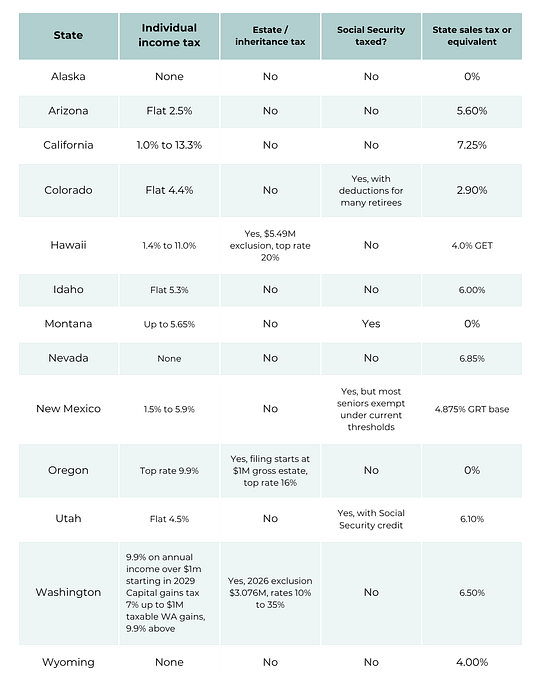
By the Numbers: Western U.S. Retirement Tax Snapshot

Once you have narrowed the list to the states you would genuinely consider, the comparison below can help frame the tax tradeoffs. It is a useful planning tool, but it should support the decision, not drive it. 

Statewide snapshot as of April 7, 2026. Use this as context, not as the decision-maker. 

Connect with us
Related Articles
Elderly couple relaxing on a pier, sharing a blanket and enjoying the sunset over the lake
Where Should You Retire? Start With Life, Then Taxes
Person looking at stock market on phone and computer
When Stress Arrives: Gold Shows Up, Bitcoin Has Not Yet

Looking for support or have a question?

Contact us to speak with one of our advisors.

[gravityform id="2" title="false" description="false" ajax="true"]